What Are the Adverse Consequences of Failing to Perform Heat Treatment on Valve Castings and Critical Components?
November 04, 2026
1. Brief Introduction
Heat treatment is an essential manufacturing process for industrial valve castings and critical components. It plays a significant role in improving mechanical properties, relieving internal stresses, refining microstructures, and ensuring dimensional stability. For valves used in high-temperature, high-pressure, and other demanding industrial applications, proper heat treatment is particularly important for long-term operational safety and reliability.
During casting, forging, welding, and machining, metallic materials experience various thermal and mechanical influences. These processes can produce residual stresses, uneven microstructures, excessive hardness, and other material defects. Heat treatment helps control these conditions and ensures that valve components meet their specified mechanical and metallurgical requirements.
Failing to perform the required heat treatment can have serious consequences, including reduced mechanical strength, cracking, deformation, poor corrosion resistance, premature wear, and unexpected valve failure. These problems can affect not only the valve's service life but also the safety and efficiency of the entire industrial system.
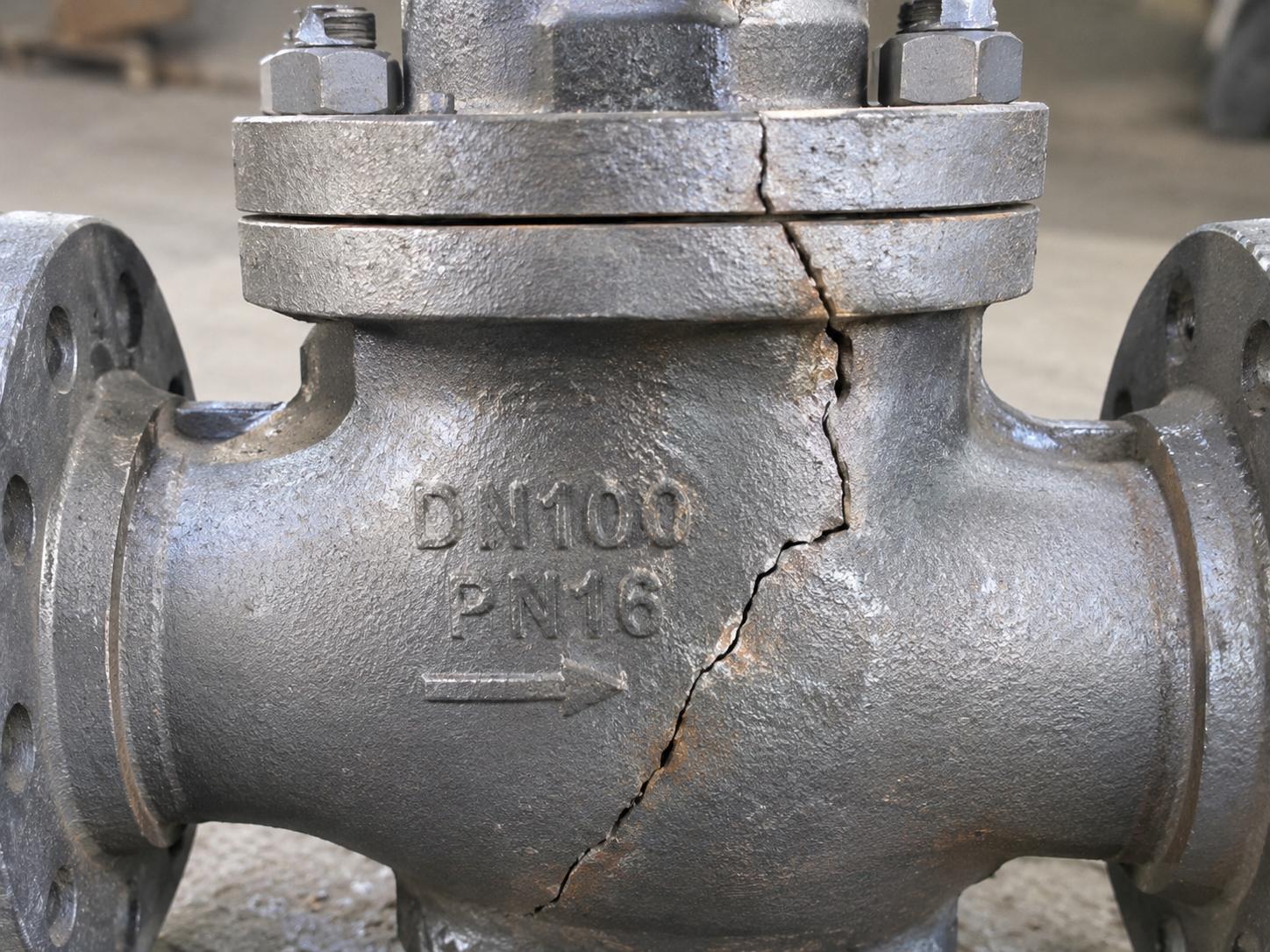
2. Increased Internal Stress and Risk of Cracking
One of the most significant consequences of omitting heat treatment is the accumulation of residual stress inside valve castings.
During the casting process, molten metal cools and solidifies at different rates throughout the casting. Thick sections cool more slowly than thin sections, resulting in uneven thermal contraction. This temperature difference generates internal stresses within the material.
Without appropriate stress-relief heat treatment, these residual stresses may remain in the valve body, bonnet, pressure-retaining components, and other critical parts.
When the valve operates under high pressure, high temperature, or repeated temperature fluctuations, the existing residual stresses combine with operational stresses. This increases the possibility of crack initiation and propagation.
Cracks may develop around casting transitions, sharp corners, flange connections, and areas with significant thickness variations. In severe cases, cracking can result in pressure leakage or catastrophic failure.
For pressure-retaining components, such as valve bodies and bonnets, this presents a serious safety risk.
3. Reduced Mechanical Properties and Material Performance
Heat treatment is designed to achieve the required combination of tensile strength, yield strength, hardness, toughness, and ductility.
When the specified heat treatment is omitted, the material may fail to achieve the mechanical properties required by its material specification.
For example, carbon steel and low-alloy steel castings may require normalizing and tempering to obtain a suitable microstructure and balanced mechanical properties.
If these processes are not properly performed, the material may exhibit uneven grain structures, inadequate toughness, or excessive hardness.
In high-pressure valve applications, insufficient mechanical performance can reduce the component's ability to withstand internal pressure, mechanical loads, and thermal stresses.
This is particularly important for power plant valves, pressure-sealed valves, high-pressure globe valves, gate valves, and check valves.
A valve casting that does not meet its specified mechanical properties should not be accepted simply because its external appearance is satisfactory.
4. Poor Microstructure and Uneven Material Properties
The microstructure of a metal directly influences its mechanical performance and service reliability.
During solidification, cast steel may develop coarse grains, segregation, non-uniform phase distribution, and other metallurgical characteristics that negatively affect performance.
Appropriate heat treatment helps refine grain structures, improve microstructural uniformity, and establish the required metallurgical condition.
Without heat treatment, different areas of the same casting may have significantly different hardness and mechanical properties.
For example, thick and thin sections of a valve body may develop different cooling structures. This can create localized areas with relatively poor toughness or excessive hardness.
Uneven microstructures can also increase susceptibility to fatigue damage and brittle fracture.
For critical valve castings, metallurgical uniformity is therefore an important quality consideration, not merely a manufacturing preference.
5. Increased Risk of Dimensional Deformation
Residual stress is also a major cause of dimensional instability during machining and subsequent operation.
When a valve body or bonnet is machined, material is removed from its surface. This changes the balance of internal stresses within the component.
If residual stresses have not been adequately relieved, the casting may gradually deform during or after machining.
Potential problems include:
- Distortion of flange sealing surfaces.
- Misalignment between valve body and bonnet.
- Changes in machining dimensions.
- Deformation of valve seat installation areas.
- Poor alignment between the stem and internal valve components.
- Difficulty achieving the required sealing performance.
These dimensional problems can affect valve assembly accuracy and sealing reliability.
In particular, pressure-retaining valve components require accurate machining dimensions and stable geometries to ensure reliable connections and prevent external leakage.
6. Reduced High-Temperature Performance
Industrial valves used in thermal power plants, petrochemical facilities, refineries, and steam systems frequently operate under elevated temperatures.
Materials such as ASTM A216 WCB, ASTM A217 WC6, WC9, and other alloy steel grades may require specific heat treatment conditions according to their material specifications.
If the required heat treatment is omitted, the material may not achieve the necessary high-temperature mechanical properties.
Potential consequences include reduced creep resistance, inadequate toughness, microstructural instability, and increased susceptibility to thermal fatigue.
Under repeated heating and cooling cycles, components with unsuitable microstructures may experience accelerated degradation.
This is particularly dangerous for high-temperature and high-pressure valves installed in main steam pipelines, boiler systems, and power station equipment.
Proper heat treatment helps ensure that the selected material performs according to its intended service conditions.
7. Increased Wear and Reduced Service Life
Heat treatment also influences the hardness and wear resistance of valve components.
Certain critical parts, including valve stems, discs, wedges, seat rings, and other contact surfaces, may require specific heat treatment to achieve the required hardness and mechanical characteristics.
If the specified treatment is not performed, components may have insufficient surface or bulk hardness.
This can result in:
- Accelerated wear between moving components.
- Increased friction during valve operation.
- Scratching and damage to sealing surfaces.
- Deformation of contact areas.
- Increased operating torque.
- Premature deterioration of valve sealing performance.
For valves used in abrasive, high-pressure, or frequently operated service conditions, these problems can significantly shorten the expected service life.
However, excessive hardness can also be harmful because it may reduce toughness and increase cracking susceptibility. Therefore, the objective is not simply to achieve maximum hardness but to meet the specified material properties.
8. Potential Deterioration of Corrosion Resistance
Heat treatment can influence corrosion resistance by controlling the microstructure and precipitation behavior of certain alloys.
This is particularly important for stainless steel castings and other corrosion-resistant materials.
For example, improperly controlled thermal conditions can promote harmful carbide precipitation in susceptible austenitic stainless steels. This may lead to chromium depletion near grain boundaries and increase susceptibility to intergranular corrosion.
Appropriate solution heat treatment, where required by the material specification, helps dissolve unwanted precipitates and restore a more suitable metallurgical condition.
For industrial valves operating in chemical processing, seawater systems, and corrosive environments, inappropriate heat treatment may contribute to premature material degradation.
It is important to recognize that not every valve material requires the same heat treatment. The correct process depends on the alloy grade, casting specification, manufacturing route, and service environment.
9. Increased Risk of Leakage and Valve Failure
All the previously mentioned problems can eventually affect the sealing performance and structural integrity of industrial valves.
Valve bodies and bonnets must withstand internal pressure while maintaining reliable sealing at body-to-bonnet connections, flange joints, and other pressure boundaries.
If castings contain excessive residual stress, unsuitable microstructures, cracks, or dimensional deformation, their ability to maintain reliable sealing may be compromised.
Potential consequences include:
- External leakage from pressure-retaining connections.
- Internal leakage caused by component deformation.
- Damage to valve seats and sealing surfaces.
- Failure during hydrostatic pressure testing.
- Premature leakage during actual operation.
For high-pressure power plant valves, even a relatively small defect can become a serious operational problem.
Therefore, heat treatment is an important part of controlling casting quality and reducing the risk of premature valve failure.
10. Increased Manufacturing Costs and Quality Risks
Although omitting heat treatment may appear to reduce manufacturing costs and shorten production time, it can create much greater expenses later.
Components that fail to meet material requirements may need additional processing, repair, replacement, or complete rejection.
Dimensional deformation may also increase machining difficulties and reduce production efficiency.
Furthermore, if an improperly treated valve passes through manufacturing and is delivered to a customer, the manufacturer may face warranty claims, customer complaints, production interruptions, and reputational damage.
For industrial valve manufacturers, maintaining a controlled heat treatment process is therefore both a technical requirement and an important quality-management responsibility.
11. How to Ensure Proper Heat Treatment Quality
To prevent these problems, valve manufacturers should establish strict heat treatment procedures for castings and critical components.
The following measures are recommended:
1. Follow Applicable Material Standards
Select heat treatment procedures according to the relevant ASTM, ASME, API, EN, or other applicable material specifications and approved technical requirements.
2. Establish Qualified Heat Treatment Procedures
Define heating temperatures, holding times, cooling methods, furnace conditions, and other essential parameters according to the material grade and component dimensions.
3. Maintain Furnace Temperature Control
Use calibrated temperature-measuring instruments and qualified furnace-control systems to ensure uniform and accurate temperature distribution.
4. Record Heat Treatment Parameters
Maintain traceable records of furnace temperature, holding time, batch numbers, material identification, and heat treatment cycles.
5. Perform Required Mechanical Testing
Conduct tensile testing, impact testing, hardness testing, and other inspections required by the applicable material specifications.
6. Conduct Necessary Non-Destructive Testing
Use appropriate radiographic testing, ultrasonic testing, magnetic particle testing, or liquid penetrant testing when required by the inspection plan and applicable standards.
7. Maintain Material Traceability
Ensure that every critical valve casting and component can be traced to its material certificate, heat number, and corresponding heat treatment records.
Failing to perform the required heat treatment on valve castings and critical components can result in serious manufacturing and operational problems. These include excessive residual stress, reduced mechanical properties, unsuitable microstructures, dimensional deformation, cracking, poor wear resistance, and potential leakage.
For valves operating under high-temperature and high-pressure conditions, these risks are particularly significant because the components must withstand continuous pressure, thermal cycling, and mechanical loads.
At SHANGTIE VALVE, heat treatment should be regarded as an essential quality-control process throughout valve manufacturing. By following applicable material standards, implementing qualified heat treatment procedures, maintaining accurate production records, and conducting appropriate inspections, manufacturers can improve material reliability and ensure that industrial valves meet their intended performance requirements.
Ultimately, proper heat treatment is not simply a manufacturing procedure. It is a fundamental measure for ensuring valve quality, operational safety, long-term reliability, and customer confidence.
NEXT: Installation and Maintenance Tips for Power Plant Valves
PREV: End